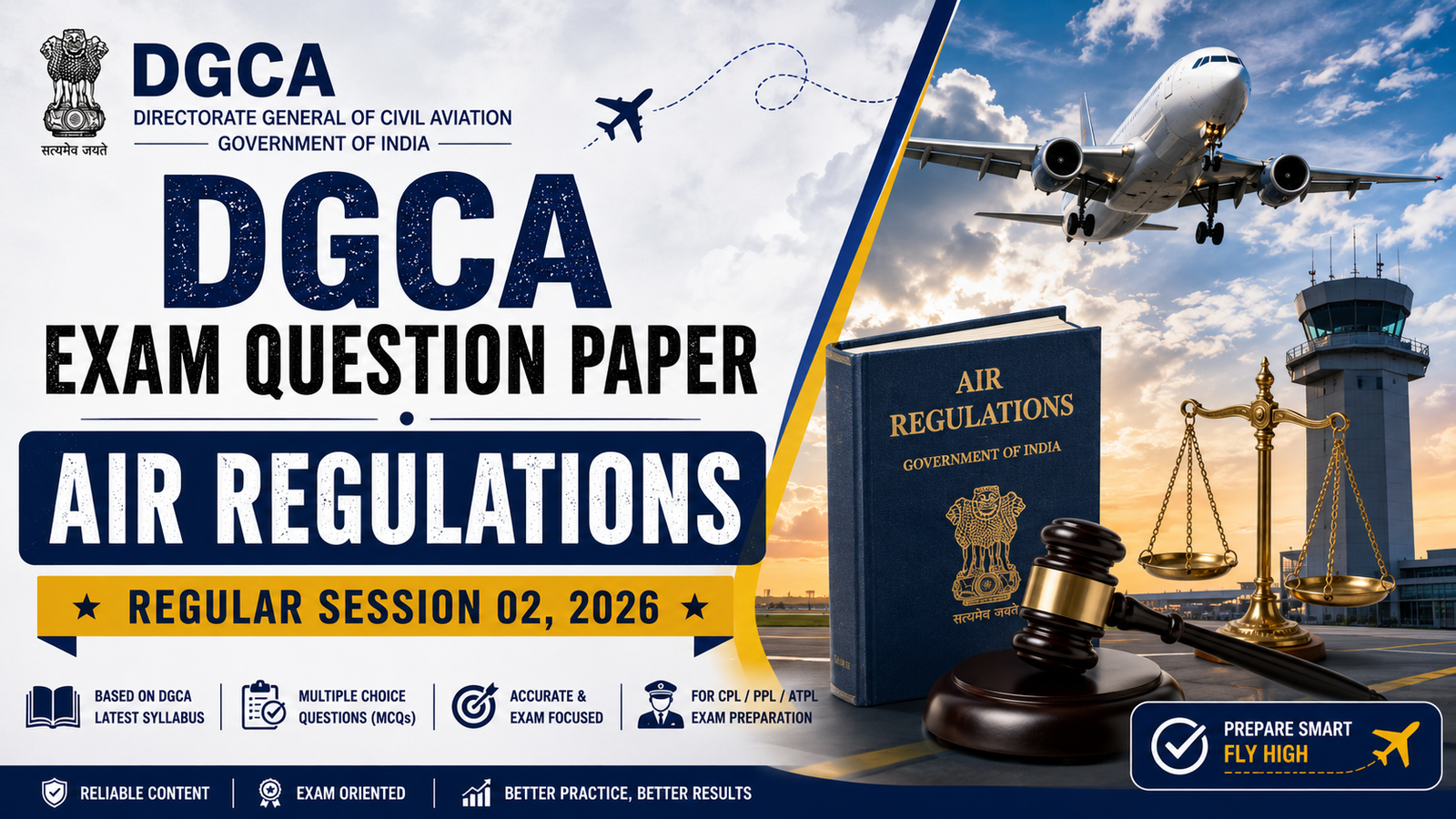

For latest free raw question paper drops and updates, connect and stay informed!
DGCA PREVIOUS YEAR QUESTION PAPERS
FOR LATEST FREE RAW QUESTION PAPER DROP AND UPDATES, CONNECT AND BE INFORMED!
👉 Connect to WhatsApp ChannelDGCA Exam Related FAQs
Q1: Is there negative marking in DGCA CPL pilot module exams?
Answer: No. DGCA pilot written exams do not feature negative marking. Scores are calculated solely based on correct responses (minimum 70% required to pass). Candidates should answer every question on the CBT screen without leaving blanks.
Q2: How many attempts are allowed for DGCA pilot exams?
Answer: Unlike CAR 66 AME modules, DGCA does not enforce a hard total attempt cap or a mandatory multi-month lock for standard CPL theory attempts. Candidates can re-appear for failed subjects in subsequent regular sessions or Online On-Demand Examinations (OLODE).
Q3: What is the minimum waiting period or re-attempt gap between failed CPL exams?
Answer: Candidates can reapply in the next available regular quarterly session or through monthly OLODE (Online On-Demand Examination) slots. In specific fast-track or on-demand setups, rules enforce a minimum 7-day to 42-day cooling-off period between re-sitting the exact same subject to prevent back-to-back blind attempts.
Q4: Are flight computers (CX-3 / CRP-5) or scientific calculators allowed in the exam hall?
Answer: Physical scientific calculators are strictly banned. However, for Air Navigation, physical navigation computers like the Jeppesen Sanderson (CRP-5) or Dalton E6B (non-electronic) are permitted at designated exam centers, along with basic on-screen digital calculators provided within the CBT exam system.
Q5: What is the exam pattern and duration for CPL subjects?
Answer: Exams are delivered via Computer-Based Tests (CBT) consisting of 50 to 100 Multiple-Choice Questions (MCQs). Duration ranges from 2 hours (Meteorology, Air Regulations) to 3 hours (Air Navigation, Technical General).
Q6: How do I book exam slots for regular DGCA pilot sessions on the Pariksha portal?
Answer: Log in to pariksha.dgca.gov.in using your Computer Number. When DGCA opens the session application window (4 times a year: March, June, September, December), select your subjects, pick your preferred exam center city, and pay the examination fees online.
Q7: What is the difference between Regular DGCA Exam Sessions and OLODE (On-Demand) exams?
Answer: Regular Sessions occur 4 times a year across all national centers for all subjects. OLODE (Online On-Demand Examination) sessions run more frequently (often monthly) at select regional DGCA exam hubs, allowing students who failed a subject to re-attempt quickly without waiting for the next main quarterly cycle.
Q8: What mandatory identification documents must I carry to the pilot exam center?
Answer: Candidates must present:
- A printed copy of the official DGCA Pariksha Admit Card.
- A valid, original government Photo ID (Aadhaar Card or Passport matching eGCA records).
- Verification details matching your registered Computer Number.
Q9: What happens if my exam fee payment fails or gets deducted without booking confirmation?
Answer: Do not make immediate duplicate payments. Log back into the Pariksha portal dashboard, access the Refund/Transaction Module, and submit your transaction ID alongside your bank account details. Failed fees are typically reconciled or refunded by DGCA within 30 to 90 days.
Q10: Why do candidates struggle most with Air Navigation and Technical General?
Answer: Air Navigation involves complex, multi-step flight calculations (drift, wind correction vectors, departure/fuel calculations, convergency). Technical General requires deep systems knowledge of turbine engines, hydraulic systems, and electrical circuits. Success relies heavily on systematic practice with authentic past question banks rather than passive reading.
Pilot FAQs
Q1: What is a DGCA Computer Number, and why is it mandatory for pilots?
Answer: A DGCA Computer Number is a unique central identification number issued to pilot aspirants via the eGCA/Pariksha portal. Without a verified Computer Number, candidates cannot book or sit for any official DGCA CPL or ATPL ground theory examinations.
Q2: What are the eligibility criteria to become a Commercial Pilot (CPL) in India?
Answer: Candidates must be at least 17 years old to start ground exams (18 years for license issuance) and must have passed Class 12 (10+2) with Physics and Mathematics from a recognized board. Non-science/Arts/Commerce students can become eligible by completing Physics and Math through the National Institute of Open Schooling (NIOS).
Q3: What is the pass mark for DGCA CPL pilot theory exams?
Answer: The passing mark for all DGCA pilot theory examinations (CPL and ATPL) is 70% (minimum 70 out of 100) per subject.
Q4: What subjects must a student pilot pass to earn a CPL in India?
Answer: Aspiring CPL holders must clear 5 primary DGCA ground subjects:
- Air Regulations (aviation laws, rules of the air)
- Air Navigation (flight planning, track calculations, radio aids)
- Aviation Meteorology (weather patterns, charts, atmosphere)
- Technical General (aircraft mechanics, engines, systems, aerodynamics)
- Technical Specific (aircraft model-specific systems, e.g., Cessna 172 or Piper Seneca)
Additionally, candidates must clear the Radio Telephony Restricted – Aeronautical [RTR(A)] examination.
Q5: Is a Class 1 Medical required before taking DGCA pilot written exams?
Answer: No. You can start appearing for DGCA CPL ground exams with a valid Class 2 Medical Certificate. However, a valid Class 1 Medical Certificate is mandatory before joining a Flying Training Organization (FTO) for flight logging and before the DGCA issues your commercial license.
Q6: What is the RTR(A) exam and who conducts it?
Answer: RTR(A)—Radio Telephony Restricted (Aeronautical)—tests standard aviation communication phraseology, emergency protocols, and radio transmission rules. It is essential for communicating with Air Traffic Control (ATC). Examinations are conducted directly through DGCA/WPC portals.
Q7: How long are passed DGCA pilot exam results valid?
Answer: Passed DGCA CPL theory papers remain valid for 5 years from the date of result declaration. Candidates must complete their required 200 flying hours and apply for their CPL within this 5-year window.
Q8: What is the difference between CPL (Commercial Pilot License) and ATPL (Airline Transport Pilot License)?
Answer: A CPL allows a pilot to fly as a First Officer (Co-Pilot) in commercial airlines or act as Pilot-in-Command (PIC) on non-airline commercial flights. An ATPL is the highest civil aviation license, allowing a pilot to command large commercial passenger airliners as Captain. ATPL theory exams cover advanced navigation, radio aids, and operational procedures.
Q9: What is the average cost and time needed to clear all DGCA CPL theory exams?
Answer: Preparing for ground classes typically takes 6 to 12 months. Exam registration fees are approximately ₹2,500 per subject for regular sessions. Most students clear all 5 subjects within 2 to 4 exam sessions with structured study.
Q10: How do previous year question papers help aspiring pilots pass CPL exams?
Answer: DGCA exams heavily test numerical calculations (in Air Navigation) and strict rule interpretations (in Air Regulations). Solving authentic past question papers helps candidates master time management, familiarize themselves with recurring question patterns, and avoid trick choices.